
| 9:36 AM (6 hours ago) | |||
| ||||

Dear Friends, I was very happy to be able to speak with Laurence O'Donnell on MSNOW last night at 10:00pm. I've been interested to observe how his commentary has become ever more informed by history and ethics. His overture last night on moral thresholds for action was very powerful. The video below is our conversation that followed. We covered a couple of topics that I have been trying to explain here on substack and elsewhere: the political logic behind the ICE deployments in chosen US cities, and the dangers of the use of mendaciou language such as "terrorist" and "assassin" by members of the Trump administration. There is also the more subtle but equally important problem of using terms, such as "law enforcement," in an inverted sense — in this case, to justify lawlessness. MSNOW posted the whole conversation, so I am just going to repost it here. 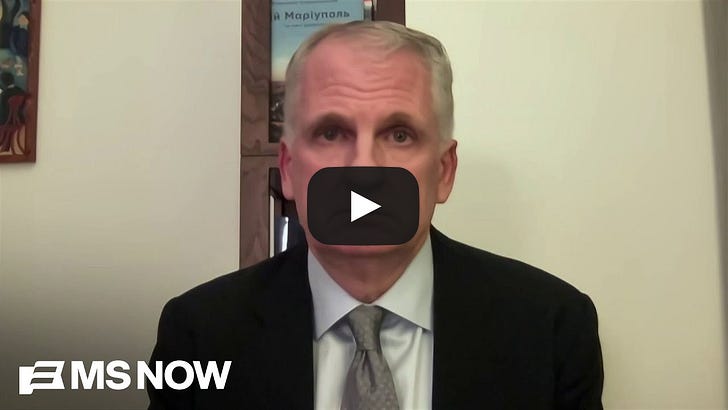 Hopefully this gets across some points in a concise way! Less concisely, if you would like… The argument about lawlessness and statelessness can be found at enormous length in my Holocaust history Black Earth, in which I also pointed (more than a decade ago) to some of the dangers that have since more visibly emerged. A similar case can be found within the foundational text of Holocaust studies, which is Destruction of the European Jews by Raul Hilberg. The warning about "dangerous words" is explained in lesson 17 of my little book On Tyranny. The lesson begins like this: "Be alert to use of the words 'extremism' and 'terrorism.' Be alive to the fatal notions of 'emergency' and 'exception.' Be angry about the treacherous use of patriotic vocabulary." But that like much of the book drew on some of the classic considerations of totalitarian language, such as Hannah Arendt's Origins of Totalitarianism, Victor Klemperer's diaries and Language of the Third Reich, and the essays of the Polish literary scholar Michał Głowinski, some of which were collected in English in 2014 (and his childhood Holocaust memoir Black Seasons is also memorable for its reflections on language). That authoritarian regimes need us to repeat their untruths is an idea of Václav Havel, whose analysis of late communism is strikingly fitting for this moment. His "Power of the Powerless" can be found in many places; I wrote a preface to this edition (in Paul Wilson's translation). George Orwell's novel 1984 also remains very powerful — I read it myself once every decade, and each time something new strikes me. My reflections on what freedom of speech would mean as a positive right are in my new book On Freedom. We all need to do what we can — but sometimes reading can help us see what we should be doing. So today I give you the brief as well as the long. Thanks for being with me! More to come this weekend. |



No comments:
Post a Comment