
| 1:05 AM (8 hours ago) | |||
| ||||

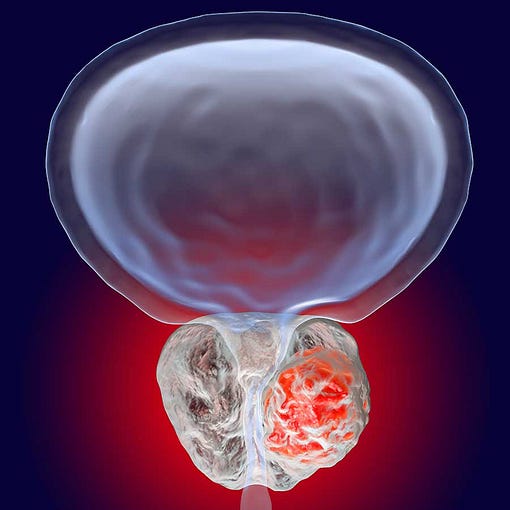
Friends, Today I want to talk about prostates. (Wait! Don't delete this post! Give me a minute to explain why you might be interested.) All of us are getting older, and some of us are becoming quite old. Many old men, like Joe Biden and me and several million others in the United States, have prostates that contain cancerous cells. But because prostate cancer grows very slowly, most of us old geezers will die with it rather than because of it. Yet some prostate cancers will threaten our lives if we do nothing about them. (A tip-off is if a man's prostate-specific antigen — PSA — starts rising.) Biden's is reported to be aggressive, prompting a wave of sympathy from normal, empathetic people. (Not surprisingly, the moment the news came out, Mr. Compassion in the Oval Office made the baseless claim that Biden had covered up his cancer while he was in the White House.) What to do? The standard treatment is a combination of radiation and drugs to lower testosterone levels (prostate cancer needs testosterone to grow). My understanding is Biden is getting both. Unfortunately, testosterone-lowering drugs have some unpleasant side effects — fatigue, weight gain, declining bone and muscle mass, reduced sex drive, impotence and erectile dysfunction, hot flashes, mood changes, liver damage, and greater risk of heart attack. Think menopause for men. Long story short, I was about to take a testosterone-reducing drug when a doctor offered a second opinion, urging me to use estrogen (estradiol) patches instead. She told me about recent research in the U.K. showing the patches to be just as effective as testosterone-reducing drugs in lowering testosterone and fighting prostate cancer — but without most of the awful side effects. Oh, and the patches are far cheaper than the drugs. So, you may ask: Why are testosterone-reducing drugs still being prescribed when they have all sorts of lousy side effects, and when estrogen patches are just as effective without most of those side effects, and they're cheaper? Answer: because pharmacy benefit managers (PBMs) prefer the more expensive drug treatment. Okay, now I need to give you a bit of background on PBMs. PBMs rake in big profits by controlling the pharmaceutical market and siphoning off some of the profits to the biggest insurance companies, from which they extract rebates. Ergo, they have every incentive to push for pricier drugs because that's where the money is. (This also explains why research into cheaper remedies is so often done in the U.K. and elsewhere rather than in the United States, where the PBMs have a lot of influence over what's researched.) Under former Federal Trade Commission Chair Lina Khan (whom I spoke with recently), the FTC released a series of damning reports on PBMs — and filed a critical antitrust case against them for inflating the prices of insulin. The FTC found that the big three PBMs — Caremark Rx, LLC (affiliated with CVS), Express Scripts, Inc. (with ESI), and OptumRx, Inc. (with OptumRx) — marked up generic drugs dispensed at their affiliated pharmacies by thousands of percent. Lina Khan says these include many lifesaving drugs, such as those to treat cancer. Which is why Pharmacy Benefit Managers have been pushing more expensive drugs to treat prostate cancer — drugs that also have worse side effects than estrogen patches. But here's the good news. Congress has just reined in PBMs. Based on the work of Senators Ron Wyden and Mike Crapo, Congress issued rules that prohibit PBMs from discriminating against smaller pharmacies or keeping any part of the rebates they extract, limiting them to flat dollar amounts rather than percentages of a drug's price, and requiring them to give their customers full pricing information. The new rules were included in the DHS spending bill that Trump signed into law Tuesday. Most of these changes will go into effect in 2028. (I don't know how Joe Biden is doing but, should you be wondering, my patches and the radiation seem to have done exactly what they needed to do. Enough said.) Be well, my friends. And be safe. |



No comments:
Post a Comment