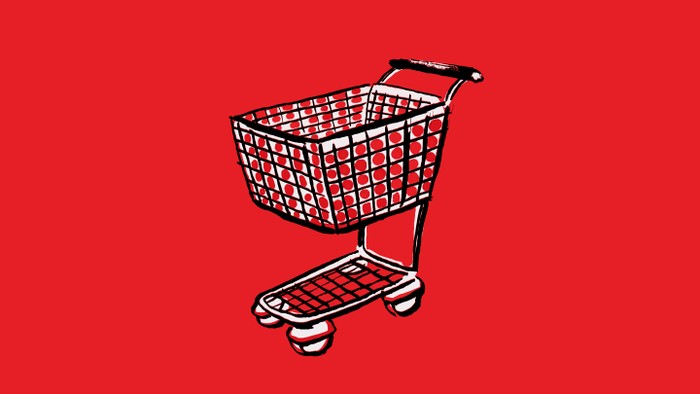
View in browser Because every day is Black Friday at Costco, I choose to go on Saturday. I like to get there early. I always park in the same spot (right next to the cart return), and wait with the other die-hards. It has the thrill of a stakeout, absent any crime or danger. When the doors open, we move toward the entrance in an orderly march. There's a small gasp upon entry—the kind of quiet awe that one feels before the most epic human achievements, as when stepping across the threshold of St. Peter's or the Chartres Cathedral. But in this place, there is no baroque majesty, no stained glass, just abundance bathed in light. In the sweep of human history generally marked by scarcity and want, here is bounty on an unimaginable scale; here is a year's supply of mozzarella sticks; here is a hot dog and a drink for $1.50; here is a monument of our civilization, in more than 600 locations across the United States. I take the ease with which I resort to Costco talk—about produce prices in particular—as a worrying sign that I've become a middle-aged bore. But there's something happening at Costco that I think goes beyond bell peppers (note that my family eats a lot of them, and, boy, are they a bargain). Costco is a marvel not just historically but also in this moment. In an age of broken institutions, insufferable politics, and billionaire businessmen auditioning to be Bond villains, most things feel like they're getting worse. Costco seems to stay the same. The employees are generally satisfied. The customers are thrilled by the simple act of getting a good deal. All of it makes a unique space in contemporary American life, a space of cooperation, courtesy, and grown-ups mostly acting like grown-ups. It starts with the thing you're pushing, the vessel into which you shall receive thy bounty. The cart is improbably large yet easily maneuvered through the warehouse's aisles. Through some invisible quality control, the sad and broken-down ones you find at the supermarket—unlevel, rear wheel locked, front wheel spinning—seem to be ushered quietly into oblivion at Costco. You're at the helm of a Peterbilt with the handling of a Porsche. Traffic is never light, but things generally move along. Pushing something that large requires an awareness of oneself in space. Those who might need to consult a list or message their spouse—should I grab this brick of cheddar cheese?—seem to know to step off to the side. At my store in Granger, Indiana, where elbows are perhaps not as sharp as at some other locations, patrons appear to have an unspoken patience with the person who wants to give a bag of avocados an extra squeeze, or hold a double shell of raspberries up to the light. There are occasional expressions of camaraderie as well: "We can't get enough of that stuff," somebody might say as you load two pillow-size bags of Pirate's Booty into the cart. You might see the bargain-hunting bonds among Costco shoppers as a function of the chain's history. To join its ranks costs $65 a year; the store's membership model originates from a nonprofit wholesale collective for federal employees called Fedco, founded in Los Angeles in the 1940s. The genealogy is complex (a three-hour-long Acquired podcast episode traces it in full), but one trait has endured: the company is animated—even as a for-profit enterprise—by the idea of bringing good value to its members. This has yielded a cultlike loyalty, such that the company can largely rely on happy members to do its advertising and marketing by word of mouth—or perhaps by wearing prized company merch. Kirkland Signature, Costco's in-house label for hundreds of products, is a kind of anti-brand that happens to be one of the world's largest for consumer packaged goods. Just buying something under its comically dull logo makes you feel like a smart shopper: You've made the wise decision to forgo a better look for a better price. Costco is a place that encourages, and rewards, just knowing the drill—and the drill isn't hard to figure out: Move along. Don't block the way. Unload your cart onto the conveyor belt with dispatch, but leave the heavy stuff. Make the barcodes visible. Violators are never exiled, but transgression, I know from experience, is not without shame. Once, I left the cart in front of the flower display loaded down with 120 pounds of water-softening salt. When I returned, the grandmother who was blocked from the flowers (find me a cheaper dozen roses!)—well, she gave me the finger. The veneer of civilization is always thin, even at Costco, as one is reminded before major holidays, or in the vicinity of the samples. When there's a Christmas feast to be provisioned, or half a bite of pizza to be tasted, order breaks down, and with it, spatial awareness, common courtesy, and the Golden Rule. We're circling like buzzards; we're blocking the way; we're shaking our heads at the nerve of the person who took the last three. But the checkout restores us to our senses. At my Costco, there is usually a line to get in line for the cashier. People can game the system, but most quietly queue up, content to wait their turn to pick a register. The clerks are cheerier than they should be before this endless current of humans and their stuff. Whatever lapses I might have had in the store (did I take a second sample? maybe), here, I'm on my best behavior. Out of the store, car loaded, cart returned, I tighten up and steel myself for the road. Have you seen the way these people drive nowadays?
|




No comments:
Post a Comment