
BREAKING: Federal Reserve Chair Jerome Powell Says He's Under Federal Investigation
The Fed chair says subpoenas and the threat of criminal charges are retaliation for refusing to set interest rates according to the president's wishes.
In a new video, Federal Reserve Chair Jerome Powell says grand jury subpoenas served on the Federal Reserve, supposedly tied to his Senate testimony about a renovation project, are being used to intimidate the Fed for setting interest rates based on economic evidence rather than political demands.
The New York Times reports that D.C. U.S. Attorney Jeannine Pirro opened a federal investigation into Powell this past November.

| 6:48 AM (10 hours ago) | |||
| ||||

The Weaponization of EverythingHow Trump turned the DOJ, DHS, and even NATO into instruments of pressure and fear
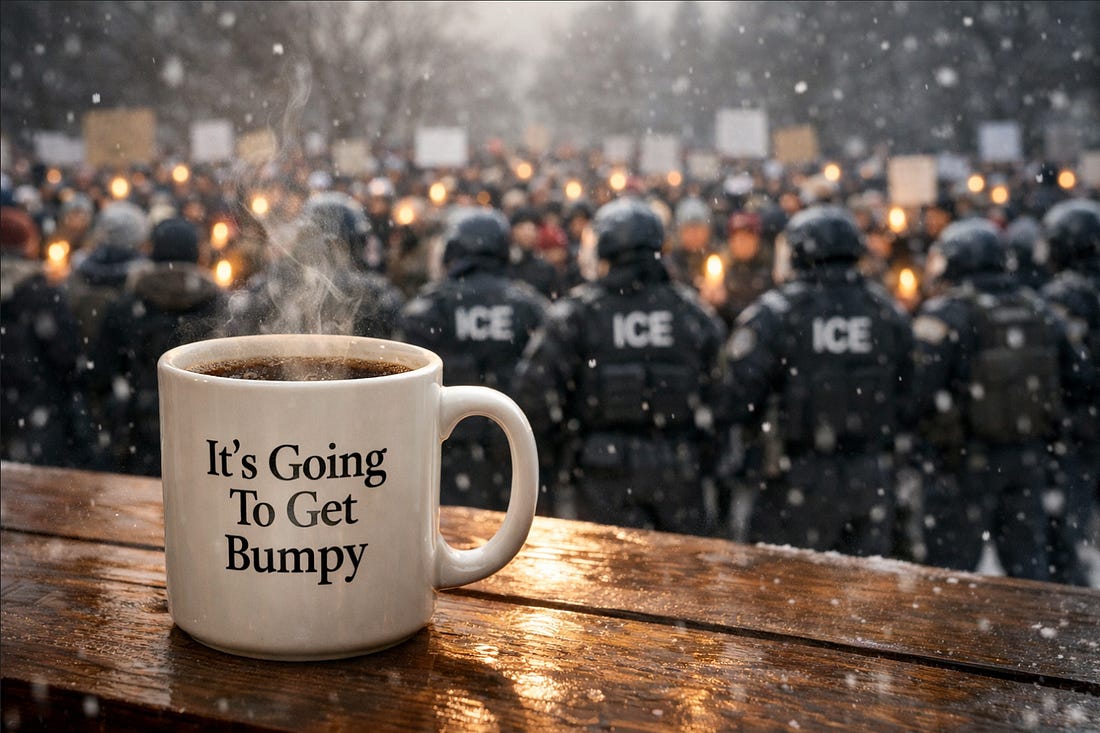
Good morning! It's another Monday in America, and the through-line today is no longer subtle. The guardrails are being tested simultaneously, loudly, and in public, from Minneapolis to the Federal Reserve to Greenland, with a federal government that seems to treat intimidation as a governing philosophy. We'll start with Donald Trump, who opened his latest press gaggle by warning reporters that there was "very rough" turbulence ahead, advice that quickly proved less about the weather than the state of American governance. What followed was Trump doing what he does best: threatening war, insulting the press, rewriting reality, and casually announcing geopolitical catastrophes like he was ordering lunch. Asked whether Iran had crossed his "red line," Trump said they were "starting to," warned that any retaliation would be met with force "at levels they've never been hit before," and then, without irony, claimed Iranian leaders had called him yesterday to negotiate. He said a meeting is being set up, though the U.S. may have to act militarily before the meeting. Russian-roulette diplomacy, now with an in-flight safety announcement. When CNN asked whether Iran takes his threats seriously, Trump sneered, "What a stupid question," before launching into a greatest-hits monologue that included Soleimani, al-Baghdadi, Venezuela, and the suggestion that wars are profitable for the United States, a thought he quickly walked back only because he wanted to sound humanitarian for half a sentence. He also reaffirmed that "one way or the other, we're going to have Greenland," dismissed NATO concerns, and declared that if the alliance didn't like it, well, they need us more than we need them. Denmark, Canada, and Europe, it turns out, disagree, and that disagreement is now more than headline noise. The EU's defense commissioner warned this weekend that any U.S. attempt to take Greenland by force would effectively spell the end of NATO, with member states legally obligated to come to Denmark's defense under EU treaty mutual-assistance commitments. French President Emmanuel Macron has been urging Europeans to reject what he calls "vassalisation heureuse", the idea that Europe should meekly drift into dependence on the United States, and instead to become "more united and stronger," capable of making its own strategic choices rather than submitting to one partner's whims.
While Trump was rattling sabers abroad, the most destabilizing escalation came at home — and not from a podium. Late Sunday night, Federal Reserve Chair Jerome Powell issued an extraordinary public video statement revealing that the Department of Justice has served the Fed with grand jury subpoenas threatening criminal indictment over his congressional testimony last summer. Powell was careful, restrained, and unmistakably direct: the investigation, he said, has nothing to do with building renovations or congressional oversight. Those are "pretexts." Powell dispensed with the usual euphemisms. He said plainly that the threat of criminal charges is the consequence of the Fed setting interest rates based on economic evidence rather than the president's preferences, an unmistakable accusation that the Justice Department is being used as a political weapon to coerce monetary policy. That a Fed chair felt compelled to say this out loud tells you how far things have gone. Powell isn't a bomb-thrower. He's an institutionalist who has spent years absorbing Trump's abuse without public comment. But this time, the quiet channels failed. The investigation, according to reporting, is being run out of the office of Trump ally Jeanine Pirro, began months ago after Trump grew angry that rates weren't falling fast enough, and follows parallel efforts to remove Fed Governor Lisa Cook. Markets responded exactly as you'd expect when investors start questioning whether central bank independence still exists: stocks slid, gold hit a record high, the dollar weakened, and long-term bond yields rose. Even Wall Street is now saying the quiet part out loud. Goldman Sachs' chief economist warned this morning that the criminal threat against Powell has "reinforced" concerns that Fed independence is under attack, though he expressed confidence Powell himself won't bend. That caveat matters, because Powell's term ends in May. The system may trust Powell, but it does not trust what comes next. Former Republican Rep. Adam Kinzinger was less diplomatic. In an emergency video, he called the move against Powell "utterly insane" and "what authoritarians do," warning that politicizing the Fed is one of the fastest ways to blow up an economy. He urged Republicans to remember they swore an oath to the Constitution, not to Donald Trump, a reminder that landed somewhere between a plea and an obituary for congressional spine. If the Fed story shows how institutional independence is being attacked from above, Minnesota shows how federal power is being exercised on the ground. The Associated Press reports that DHS has launched what it calls its largest enforcement operation ever in the state, with agents ramming doors, forcing entry into homes without judicial warrants, and arresting people in neighborhoods already on edge after ICE shot and killed 37-year-old U.S. citizen Renée Good. Video captured agents pushing past protesters and dragging a man out of a home using only an immigration officer–signed document, which does not authorize forced entry into a private residence. The administration's response to public outrage has not been restraint, transparency, or accountability. Homeland Security says more agents are coming. Trump has floated "absolute immunity" for officers, and officials have moved immediately to smear critics as "agitators" and "paid" operatives, the same language Trump used in his gaggle, where he described protesters as "professional agitators" and suggested he'd like to know "who's paying for it." A short Washington Post documentary shows where that rhetoric leads. In Charlotte, North Carolina, Border Patrol agents swept through neighborhoods while volunteers known as "ICE verifiers" filmed operations, alerted neighbors, and documented vehicles, all constitutionally protected activity. At least eight of those verifiers were arrested, including one man dragged from his car and handcuffed after photographing a federal vehicle. DHS now claims that filming agents "impedes investigations," effectively criminalizing observation itself. Cameras and documenting are the real threat. Hovering over all of this is a chilling bit of ideological signaling. ICE has been circulating a recruitment ad bearing the slogan "We'll Have Our Home Again," paired with frontier imagery and militarized symbolism. That phrase is not neutral, it traces directly to a white-nationalist song, often rendered as "By God, We'll Have Our Home Again", with roots in neo-Nazi circles and later adopted by Canada's white supremacist Diagolon movement. To most viewers, it sounds vague and patriotic, but to extremist audiences, it's unmistakable. Dog whistles work because the right people hear them clearly. Put it all together, and the pattern snaps into focus. DHS escalates force and demands immunity when communities resist, and protesters become "agitators", witnesses become criminals, and allies become obstacles. Institutions that assert independence are told, politely at first, then legally, then forcefully, to fall in line. Minnesota shows how bodies are treated, Powell shows how institutions are treated, Greenland shows how allies are treated, and Trump's own words tie it together. "One way or the other, we're going to have Greenland," "They won't even believe it," "What a stupid question", a refrain that underscores not just a loss of decorum but a systemic unraveling in which force, intimidation, and spectacle have become the currency of American power, a reality it's hard to fathom in a nation that once prided itself on restraint, norms, and the rule of law. |




No comments:
Post a Comment